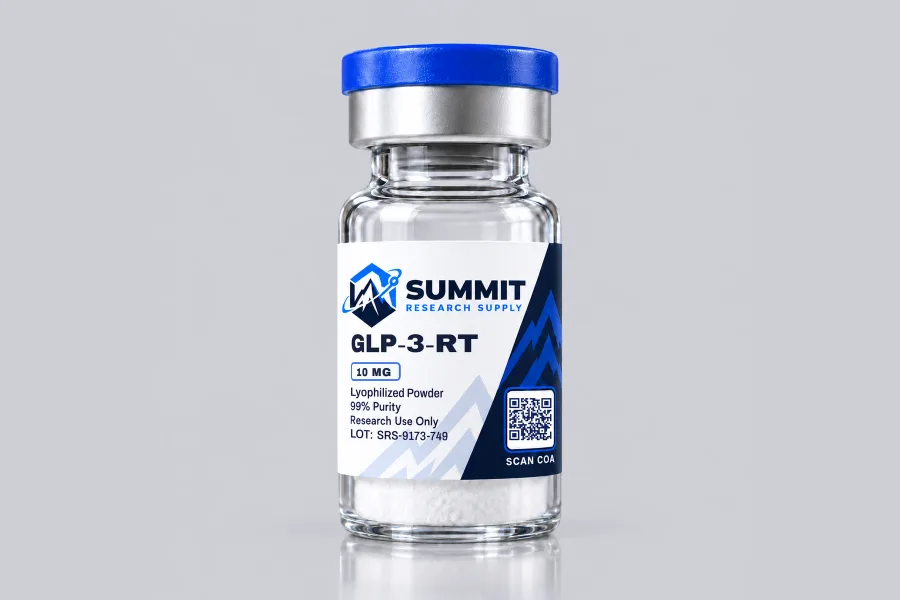
BPC-157 (10 mg vial)
Once daily subcutaneous protocol for tissue-repair research.
BPC-157 is a synthetic pentadecapeptide derived from a protective protein in gastric juice, with an unusually consistent rodent literature across tendon, muscle, gut and vessel injury models and no human trials at all. The protocol below is the community-standard once-daily subcutaneous approach, injected near the problem area when practical.
Quick answer: at the standard 10 mg + 1 mL reconstitution, a 600 mcg dose of BPC-157 draws 6 units (0.06 mL) on a U-100 insulin syringe, once daily subcutaneous.
Get BPC-157 → code PEPDOSE
Protocol overview
Dosing & reconstitution
Frequency: Once daily subcutaneous
Typical duration: 8-12 weeks
Reconstitution: 10 mg vial + 1 mL bacteriostatic water = 10 mg/mL. Units below are for a U-100 insulin syringe at this concentration.
| Phase | Dose | Units per injection |
|---|---|---|
| Weeks 1-2 | 200 mcg | 2 units (0.02 mL) |
| Weeks 3-4 | 400 mcg | 4 units (0.04 mL) |
| Weeks 5-8+ | 600 mcg | 6 units (0.06 mL) |
Units = (dose ÷ concentration) × 100 on a U-100 syringe. Change the vial size or water volume and the calculator redoes all of this for you.
Track this protocol → Free account · log doses, rotate sites, never lose your history
BPC-157 dosing — what the literature actually supports
We publish a schedule when there is a citable human source and we say so when there is not. Filling this space with a number nobody measured would make the page look more complete and be worth less than nothing to you.
What the published studies actually administered
These are the amounts that appear in the actual published work, reported as published. They are animal doses and cell-culture concentrations, not human protocols.
| Work | Amount used | Route | Context |
|---|---|---|---|
| Rodent injury models (Sikiric group, dozens of papers) | 10 ng/kg or 10 μg/kg, typically once daily | Intraperitoneal, intragastric, or topical by model | The two canonical doses repeated across the gut, tendon, muscle and vessel studies |
| Tendon fibroblast work (Chang 2011) | ng/mL to μg/mL in culture medium | In vitro | Concentrations in a dish, not doses in a body |
Reconstitution and measurement
This part is arithmetic and does not depend on the evidence level. Concentration is vial size divided by the bacteriostatic water you add. Draw volume is your target amount divided by that concentration. Units are draw volume times 100, because a U-100 syringe reads 100 units per millilitre. Common vials for BPC-157: 10, 20 mg.
- Wipe the stoppers of both vials with an alcohol swab and let them dry.
- Draw the bacteriostatic water with a sterile syringe and inject it slowly down the inside wall of the peptide vial — never straight onto the powder.
- Swirl gently until the solution is clear. Do not shake; foaming and agitation damage peptides.
- Label the vial with the date and concentration, and refrigerate at 2–8 °C protected from light.
Worked example at the calculator defaults: 10 mg + 2 mL of bacteriostatic water = 5 mg/mL, so on a U-100 insulin syringe 1 unit = 50 mcg of BPC-157. Change either input and the calculator redoes this for you.
Storage and stability
Supplies math
Whatever amounts your research uses, the planning arithmetic is the same. The calculator runs all of this per compound.
Supplies by protocol length
Based on the maintenance dose above (600 mcg, once daily subcutaneous) and a 10 mg vial reconstituted with 1 mL.
| Duration | Injections | Vials | Syringes | Bac water | Swabs |
|---|---|---|---|---|---|
| 8 weeks | 56 | 4 x 10 mg | 62 | 1 x 10 mL | 112 |
| 12 weeks | 84 | 6 x 10 mg | 93 | 1 x 10 mL | 168 |
| 16 weeks | 112 | 7 x 10 mg | 124 | 1 x 10 mL | 224 |
Syringe count includes ~10% spares. Swabs = 2 per injection (stopper + site). Vial count assumes the full maintenance dose for the entire duration.
Important notes
Practical considerations for consistency and safety.
- Use a new sterile insulin syringe for each injection and dispose in a proper sharps container.
- Rotate injection sites (abdomen, thighs, upper arms) systematically to reduce local irritation and avoid lipohypertrophy.
- Inject slowly and steadily; wait a few seconds before withdrawing the needle to ensure complete delivery.
- Administer at the same time each day for consistent levels. Setting a daily reminder helps maintain the schedule.
- This compound lacks controlled human safety data. Start with the lowest reported amount and increase gradually while monitoring for any adverse reactions.
- The 10 mg vial size is standard for this compound. Reconstitute with 1 mL bacteriostatic water for a convenient concentration.
How BPC-157 works
A synthetic pentadecapeptide derived from a sequence found in human gastric juice. Rodent work reports accelerated tendon, muscle and gut healing, with effects on angiogenesis and nitric-oxide signalling proposed as mechanisms.
Benefits & side effects
Potential benefits
- Consistently accelerates healing in rodent injury models
- Anti-inflammatory and cytoprotective in preclinical work
- Wide therapeutic window reported in animal studies
- Supports tendon, muscle, gut and vessel healing in models
Possible side effects
- No human safety data from controlled trials
- Injection site reactions
- Added to sport prohibited monitoring in 2022
- All safety information is from animal models
This list reflects published literature and community reports. Individual responses vary. Not medical advice.
Bloodwork worth tracking
The community-standard practice is a baseline panel before starting, a recheck 8 to 12 weeks in, and another after time off. For BPC-157, the markers most worth watching:
CMPCBC
Typical time off: 2-4 wks
Lab panels are how a research protocol stays honest: numbers move before symptoms do. Interpretation belongs with a clinician. Not medical advice.
Lifestyle factors
None of the literature above was run on a background of poor sleep and no protein. These variables move outcomes more reliably than any compound on this site.
- Tendon and muscle models in the literature pair the compound with controlled loading — tissue adapts to progressive load, and no rodent study used bed rest as the protocol.
- Protein intake and overall energy availability set the ceiling on any repair process being studied.
- Sleep is when most tissue-repair signalling happens; it is the cheapest variable in the whole model.
- For an actual injury, a qualified clinician and a rehab plan are the intervention with human evidence behind them.
Subcutaneous technique and practical notes
General best practice from clinical injection guidance — the same fundamentals nurses are taught, none of it specific to any compound.
References
- Sikiric P, et al. Stable gastric pentadecapeptide BPC 157: novel therapy in gastrointestinal tract. Current Pharmaceutical Design, 2011. — find on PubMed
- Chang CH, et al. The promoting effect of pentadecapeptide BPC 157 on tendon healing involves tendon outgrowth, cell survival, and cell migration. Journal of Applied Physiology, 2011. — find on PubMed
- Seiwerth S, et al. BPC 157 and blood vessels. Current Pharmaceutical Design, 2014. — find on PubMed
- Vukojevic J, et al. Rat inferior caval vein occlusion and BPC 157 (vascular recruitment). Vascular Pharmacology, 2018. — find on PubMed
Broader literature searches:
Quick answers
How many syringe units is a 600 mcg dose of BPC-157?
At the standard reconstitution of 10 mg with 1 mL bacteriostatic water (10 mg/mL), a 600 mcg dose draws 6 units (0.06 mL) on a U-100 insulin syringe.
How do you reconstitute BPC-157?
Add 1 mL of bacteriostatic water to the 10 mg vial for 10 mg/mL. Inject the water slowly down the inside wall of the vial, swirl gently without shaking, and refrigerate at 2 to 8 °C after mixing.
How long does a 10 mg vial of BPC-157 last?
About 16 maintenance doses of 600 mcg, roughly 2.3 weeks at once daily subcutaneous.
Does BPC-157 have human trial data?
No. The evidence base is animal and cell studies; the practical dosing shown is community convention, and the page labels it that way.
How does BPC-157 work?
A synthetic pentadecapeptide derived from a sequence found in human gastric juice. Rodent work reports accelerated tendon, muscle and gut healing, with effects on angiogenesis and nitric-oxide signalling proposed as mechanisms.
Popular stacks with BPC-157
Compounds people commonly research alongside BPC-157. Each is its own vial with its own calculator and evidence.
BPC-157 + TB-500
Sourcing BPC-157
Whatever you are working with, the documentation matters more than the price. Ask for a batch certificate of analysis whose lot number matches the vial you actually receive — a COA for a different batch tells you nothing about yours.
BPC-157 at Summit Research Supply → Grade a COA first
Summit is the supplier we feature and an affiliate link. Our COA checklist applies the same way to any vendor.