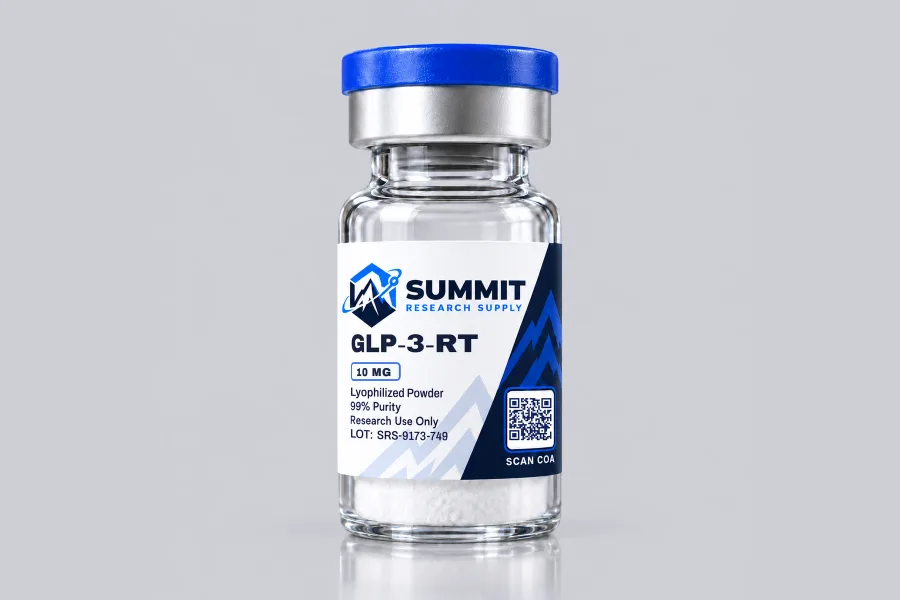
Storage & stability reference
What form the material is in matters more than anything else: lyophilized powder is stable and tolerant, and the same peptide in solution is neither. This is the reference table, plus the handling factors that shorten a window.
Storage by form
| Form | Store at | Realistic window | Notes |
|---|---|---|---|
| Lyophilized powder, unopened | Freezer, −20 °C | Long-term. This is the stable form — the one to keep if you are not using the vial soon. | Keep sealed; peptides are hygroscopic and absorbed moisture shortens shelf life. |
| Lyophilized powder, short term | Refrigerated, 2–8 °C | Suitable for weeks to months for most compounds. | Fine if the vial is going into use reasonably soon. Avoid repeated warming. |
| Reconstituted, general peptide | Refrigerated, 2–8 °C, dark | A limited window — plan in weeks, not months. | Never freeze. Freeze-thaw damages peptides in solution. |
| Reconstituted, less stable compounds | Refrigerated, 2–8 °C, dark | Shorter still. Reduced glutathione oxidises readily; IGF-1 analogs are less robust than short peptides. | Discard on any colour change or particle formation. |
| In transit | Ambient, briefly | Lyophilized powder tolerates short ambient shipping — this is why it ships dry. | Refrigerate on arrival. Brief ambient exposure of dry powder is not a problem. |
| Any vial showing cloudiness | Discard | Not applicable. | Cloudiness or visible particles mean precipitation, degradation or contamination. None are recoverable. |
What shortens a window
Light
Several peptides are photosensitive. Amber vials help; a dark drawer or box works just as well and costs nothing.
Temperature cycling
Repeatedly warming and re-cooling a vial is harder on it than a stable temperature. Take out what you need and put it back.
Agitation
Shaking and foaming denature peptides. This applies at mixing and afterward — do not shake a reconstituted vial to "remix" it.
Diluent choice
Bacteriostatic water’s 0.9% benzyl alcohol suppresses microbial growth, which is what makes multi-entry reasonable. Sterile water offers no such protection once entered.
Number of entries
Every needle entry is an opportunity for contamination. Swab the septum each time, and use a fresh needle.
Concentration
More dilute solutions are generally less stable than concentrated ones, because there is proportionally more surface for adsorption and oxidation.