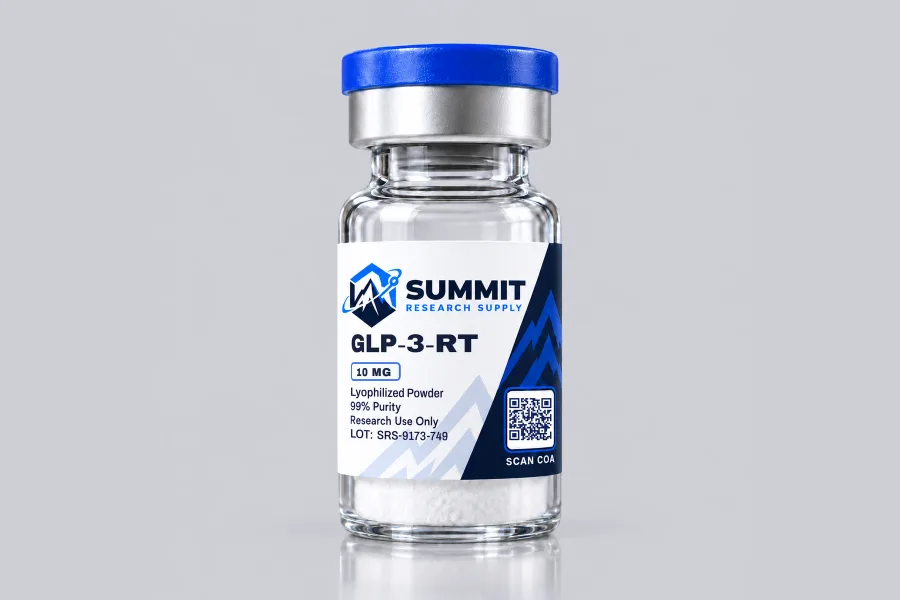
Peptide reconstitution supplies checklist
Everything needed to reconstitute, measure, store, and dispose of research material cleanly — sorted by what is genuinely required versus what just makes repeat work easier. Read the reconstitution guide first, and run your numbers through the calculator.
The short version
- Seven items are genuinely required: bacteriostatic water, insulin syringes, a mixing syringe, prep pads, hand sanitiser, surface wipes, and a sharps container.
- Bacteriostatic water is preserved, so a vial survives repeated stopper punctures — plain sterile water is single-use.
- Order prep pads at two per draw; they run out roughly twice as fast as syringes.
The complete checklist
Grouped by tier. Required items belong in every setup. Recommended items keep handling cleaner across repeated use. Optional items matter mostly for travel or longer projects.
Required
Recommended
Optional
Companion supplies & routine support
Ordinary consumer products people often keep alongside a research routine. These are not research materials and are not part of reconstitution — they are here for convenience, grouped so you can skip whatever is irrelevant to you.
Skin routine 9
Commonly kept alongside cosmetic-research compounds such as GHK-Cu.
GLP-1 & digestive support 3
Products people commonly keep on hand around GLP-1 research.
Vitamins & minerals 7
General-purpose supplements. Bloodwork beats guessing on any of these.
Protein, creatine & metabolic 4
Standard training-support staples.
Bacteriostatic water vs sterile water vs saline
Bacteriostatic water is sterile water with 0.9% benzyl alcohol added as a preservative. That preservative is the whole point: it lets a vial tolerate repeated stopper punctures over days or weeks instead of being compromised after the first one. For anything reconstituted and then stored, it is the default.
Sterile water has no preservative. It is fine for single-use work where the vial is finished in one sitting, and not appropriate for a vial you intend to return to.
Sodium chloride solution is not a general substitute. Some compounds are measurably less stable in saline, and it carries no preservative either, so it does not solve the problem bacteriostatic water solves. Check what your specific material is documented to be stable in rather than assuming.
Full detail in the bacteriostatic vs sterile water guide.
Syringes and needles: what to get
Two different jobs, two different syringes. Trying to do both with one is where most of the frustration comes from.
Insulin syringes, for measuring
U-100, 29–31G. The barrel size sets how readable your draw is: a 0.3 mL (30-unit) barrel has the finest graduations, 0.5 mL and 1 mL barrels cover bigger draws with coarser markings. Pick the smallest barrel your draw fits inside.
A mixing syringe, for reconstitution
18–22G, 1–3 mL. Moving a full millilitre of bacteriostatic water through a 31G insulin needle is slow, and forcing it risks foaming the solution. A wider bore does that step in seconds.
Aim the stream at the glass
Whatever you mix with, run the diluent down the inside wall of the vial rather than blasting it directly onto the powder. Then swirl — never shake.
The syringe sizes guide covers barrel choice in depth, and U-100 units explained covers reading the markings.
How much of each to order
Running out of syringes partway through is the common annoyance. The arithmetic is short: count the draws you expect over the period you are planning, then add about 10% for dropped or wasted units.
| Item | Rule of thumb | Example: 8 weeks, 2 draws/week |
|---|---|---|
| Insulin syringes | 1 per draw, +10% | ~18 |
| Alcohol prep pads | 2 per draw (stopper + surface) | ~36 |
| Mixing syringes | 1 per vial reconstituted | 1 per vial |
| Bacteriostatic water | Sum the diluent volume across vials, +1 vial spare | Depends on vial count |
| Sharps container | 1 per ~100 units, sized to your run | 1 |
Prep pads are the item people consistently under-order — at two per draw they empty roughly twice as fast as syringes. Bacteriostatic water depends entirely on how many vials you reconstitute and at what concentration; the calculator gives you the per-vial diluent volume to total up.
Sharps disposal
Used needles go into a rigid, puncture-resistant sharps container — nothing else. Once it reaches the fill line, seal it and take it to a proper drop-off. Most US counties run a household sharps programme, and many pharmacies and clinics accept full containers; check your county health department for the local rule, which varies by state.
Labels, gloves, and storage
Small habits that prevent the errors a calculator cannot catch.
Label every vial
Compound, reconstitution date, and final concentration, written on the vial itself. An unlabelled vial a fortnight later is the single most common cause of a mis-measured draw — the maths is only as good as knowing what is in the glass.
Cold and dark
Lyophilised material is comparatively stable; once reconstituted it wants refrigeration and no light. A storage case handles the light and keeps everything in one place.
Gloves are about the vial
Powder-free nitrile keeps skin oils off stoppers and work surfaces. Powder-free specifically, so nothing sheds where you are working.
Travel means cold
An insulated case with a frozen pack covers transport. Do not let reconstituted material sit at room temperature for a journey.
More in the storage guide and common reconstitution mistakes.
Frequently asked questions
What do I actually need to reconstitute a peptide?
At minimum: bacteriostatic water, a mixing syringe to move the water, U-100 insulin syringes for measured draws, alcohol prep pads, and a sharps container. Everything else on this page makes the process tidier or safer over repeated use, but those six are the working set.
Bacteriostatic water or sterile water?
Bacteriostatic water contains 0.9% benzyl alcohol as a preservative, so a multi-use vial stays usable after repeated stopper punctures. Plain sterile water has no preservative and is single-use. For anything reconstituted and stored, bacteriostatic is the standard choice.
Can I use saline instead?
Sodium chloride solution is not a general substitute. Some compounds are noticeably less stable in saline, and it carries no preservative, so it does not solve the multi-use problem bacteriostatic water solves. Check what the material you are working with is documented to be stable in.
What syringe size should I use?
Match the barrel to the draw. A 0.3 mL (30-unit) U-100 barrel has the finest graduations and is easiest to read for small volumes; 0.5 mL and 1 mL barrels cover larger draws with coarser markings. The calculator returns the exact unit reading either way.
Do I need a separate needle for mixing?
It helps. Reconstitution moves a whole millilitre or more of diluent, which is slow through a 31G insulin needle, and pushing bacteriostatic water hard through a fine needle risks foaming the solution. A wider 18–22G syringe handles that step, then the insulin syringe handles measured draws.
How many syringes should I order?
Count the draws you expect over the period you are planning, then add roughly 10%. Prep pads should be ordered at two per draw — one for the stopper before drawing, one for the work surface — so they run out about twice as fast as syringes.
How do I dispose of used needles?
Into a rigid, puncture-resistant sharps container, never loose into household rubbish or recycling. Do not recap, bend, or clip needles. Most US counties run a household sharps drop-off, and many pharmacies take full containers.
Are generic syringes from a marketplace fine?
Look for individually sealed, sterile, single-use units from a seller with consistent lot information. The failure mode worth avoiding is bulk-packed or loose units with no lot marking — not the price.