SNAP-8 Reconstitution & Concentration Calculator
This free SNAP-8 calculator turns your vial size, the diluent you add, and your target amount into a concentration, a draw volume, and the exact units on a U-100 insulin syringe. SNAP-8 is a cosmetic-ingredient peptide, and its published human work is entirely topical — multi-ingredient serums and dissolving microneedle patches — so the useful output on this page is concentration, which is how that literature states things, rather than an amount.
SNAP-8 reconstitution calculator
Syringe
U-100 insulinPeptide in vial
Target amount
Bacteriostatic water
Email this result to yourself
Quick summary
- Converts vial size (mg), diluent volume (mL), and a target amount into concentration, draw volume, and U-100 units.
- Reference math for the 10 mg vial, with the mg/mL to % w/v conversion the cosmetic literature uses.
- Educational research and measurement tool only — it does not diagnose, treat, or recommend an amount.
What this SNAP-8 calculator does
This calculator does one job well: it turns your vial size, the amount of bacteriostatic water you add, and your target amount into a concentration (mg/mL), a draw volume (mL), and the matching units on a U-100 insulin syringe. Change any input and the result updates instantly.
SNAP-8 ships as a freeze-dried powder. Before it can be measured into a syringe it has to be reconstituted — dissolved in bacteriostatic water. How much water you add sets the concentration, and the concentration sets how many units each amount works out to. The presets above cover the most common SNAP-8 vial setups; use the custom fields for anything else.
How to use the SNAP-8 calculator
Pick your syringe
Choose the U-100 insulin syringe you'll draw with. Smaller syringes (0.3 mL / 30u) have finer lines, which helps when the draw is small.
Enter your vial and water
Set the milligrams in your SNAP-8 vial and the bacteriostatic water you added. Together these set the concentration.
Set your target amount
Toggle mg or mcg and pick (or type) the amount you're measuring for. The calculator does the conversion for you.
Read the draw
The result panel shows concentration, draw volume, and the exact U-100 units to pull, plus how many doses your vial contains.
SNAP-8 reconstitution math, explained
The math is short. Concentration = vial size ÷ bacteriostatic water. Draw volume = target amount ÷ concentration. Units = draw volume × 100 (a U-100 syringe reads 100 units per mL). The table below shows common SNAP-8 setups and the units for a 1 mg amount at each.
| Vial size | Bac water | Concentration | Units per 1 mg |
|---|---|---|---|
| 10 mg | 1.0 mL | 10 mg/mL | 10 units (at the quoted solubility limit) |
| 10 mg | 2.0 mL | 5 mg/mL | 20 units |
| 10 mg | 4.0 mL | 2.5 mg/mL | 40 units |
| 10 mg | 5.0 mL | 2 mg/mL | 50 units |
SNAP-8 amount-to-units reference
How common amounts convert to U-100 syringe units at two example concentrations. These are arithmetic conversions for reference, not a recommendation of any amount.
| Amount | Volume (mL) | U-100 units |
|---|---|---|
| 0.25 mg (250 mcg) | 0.05 mL | 5 units |
| 0.5 mg (500 mcg) | 0.1 mL | 10 units |
| 1 mg (1000 mcg) | 0.2 mL | 20 units |
| Amount | Volume (mL) | U-100 units |
|---|---|---|
| 0.25 mg (250 mcg) | 0.1 mL | 10 units |
| 0.5 mg (500 mcg) | 0.2 mL | 20 units |
| 1 mg (1000 mcg) | 0.4 mL | 40 units |
Mixing, color & storage tips
What the human literature actually is
At least five peer-reviewed human studies and one case report include acetyl octapeptide-3, and every one of them is topical, multi-ingredient and industry-linked — commercial serums used twice daily and dissolving hyaluronic-acid microneedle patches. Most had no control group. None reports a SNAP-8 amount in milligrams or micrograms; the single published concentration is 0.03% inside a patch formulation that also carried vitamin C and a lysophosphatidic acid derivative. There is no human or animal study of injecting it and no pharmacokinetic data by any route.
Percent is the unit that literature uses
Because the published figures are formulation percentages, the conversion is the useful one: 10 mg/mL is 1% w/v, 5 mg/mL is 0.5%, 2.5 mg/mL is 0.25% and 2 mg/mL is 0.2%. That arithmetic is exact. What it cannot do is bridge routes — a percentage in a cream or a patch describes what is in the product, not what reaches tissue, and it does not convert into an injected amount.
Solubility puts a floor under the diluent volume
The supplier specification quoted in the published patch study is 10 mg/mL in water, and the one published analytical method paper prepared stocks at that same 10 mg/mL. A 10 mg vial with 1 mL therefore sits exactly at the quoted ceiling; 2 mL or more leaves headroom, which is why the presets here start at 2 mL.
Check identity by mass, not just purity
Ac-EEMQRRAD-NH2 is C41H70N16O16S at about 1075.2 daltons (PubChem CID 76283482). The published LC-MS/MS method reports a precursor ion at m/z 538 for the doubly charged species, quantified on the 538 to 102 transition. Watch for a trap here: a second PubChem record labelled acetyl octapeptide-3 (CID 71587832) carries a malformed structure and a different formula, and it has been repeated in at least one review table, so a certificate matching those numbers is not reassurance.
Methionine, and what is not known about storage
The sequence contains a methionine, which oxidises readily in peptides generally, so keep air and light exposure low. The only published stability figure is dilute SNAP-8 in distilled water holding steady over 96 hours at 4 degrees Celsius. Nothing published covers benzyl-alcohol bacteriostatic water or the shelf life of a reconstituted vial, so refrigerate, protect from light, swirl rather than shake, and plan around a limited window.
SNAP-8 supplies checklist
A simple reconstitution shopping list. Confirm vial size and batch documentation before you buy.
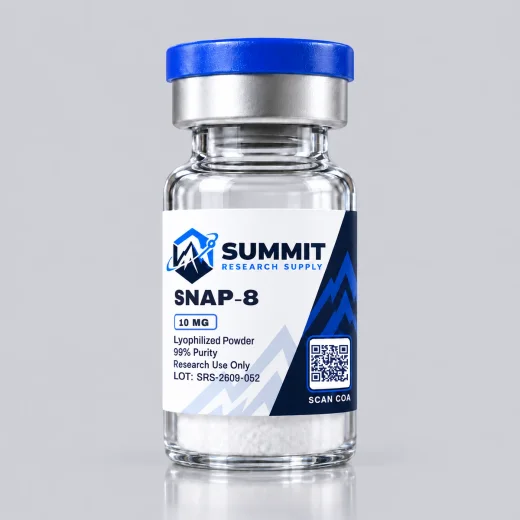
SNAP-8
- Batch COA on every vial
- Third-party purity tested
- U.S. fulfillment, discreet shipping
SNAP-8 — frequently asked questions
What does this SNAP-8 calculator tell me?
It converts your vial size, diluent volume, and target amount into concentration in mg/mL, draw volume in mL, and U-100 syringe units. It is a measurement tool, not a recommendation.
Is the SNAP-8 calculator free?
Yes — free, browser-based, and no account is required.
What is 5 mg/mL of SNAP-8 as a percentage?
It is 0.5% w/v. The conversion is straightforward: 10 mg/mL is 1%, so 5 mg/mL is 0.5% and 2.5 mg/mL is 0.25%. That matters because the cosmetic literature states SNAP-8 as a percentage of a finished product rather than as a weight.
Is there an established SNAP-8 dose?
No. Published human use is topical and always inside a multi-ingredient product, and no study reports a SNAP-8 amount in milligrams or micrograms — the only concentration published is 0.03% in a microneedle patch. There is no injected human or animal data, and the most-quoted efficacy percentages circulating for it come from the manufacturer rather than from independent trials.
Is SNAP-8 the same as Argireline?
It is Argireline (acetyl hexapeptide-3, also sold as -8) with two extra residues on the end. They are not interchangeable as evidence. Argireline has an independent placebo-controlled trial and peer-reviewed mechanism work behind it; SNAP-8 has neither of its own, and its inhibition figures trace back to manufacturer data repeated secondhand in reviews.
Is this medical advice?
No. This page and calculator are for education and research planning only. Products referenced are sold strictly as research chemicals and are not for human or veterinary use.
Sources & further reading
- Shin JY et al. Dissolving microneedle patch containing 0.03% acetyl octapeptide-3, Ann Dermatol 2024 (PMID 39082657).
- Avcil M et al. Bioactive peptides on hyaluronic acid microneedle patches, J Cosmet Dermatol 2020 (PMID 31134751).
- Moy M et al. Peptide-pro complex serum in aged skin, J Cosmet Dermatol 2023 (PMID 35426243) — uncontrolled, industry-funded.
- Draelos ZD, Diaz I. A multimechanistic antiaging skin technology, Dermatol Ther (Heidelb) 2023 (PMID 37861918) — uncontrolled, industry-funded.
- McCall-Perez F et al. Facial serum for fine lines and photodamaged skin, J Clin Aesthet Dermatol 2011 (PMID 21779421) — single-arm, industry-funded.
- Sahni G, Kassir M. DermaFrac microchannelling with a serum containing acetyl octapeptide-3, J Cutan Aesthet Surg 2013 (PMID 24163534) — a single-patient case report.
- Ji M et al. LC-MS/MS method for acetyl octapeptide-3, J Anal Sci Technol 2020 — source of the mass-spec transitions and the 4 degrees Celsius stability figure.
- PubChem — acetyl octapeptide-3, CID 76283482 (C41H70N16O16S, MW 1075.2). Note CID 71587832 carries a malformed structure.
- ClinicalTrials.gov — search for acetyl octapeptide-3; no registered studies.
- General peptide reconstitution and storage best practices.
Related calculators
SNAP-8 protocol & evidence
There is no established human dosing schedule for SNAP-8 — the published work is animal or cell-culture research. The protocol page explains what that work does and does not show.