Pinealon Reconstitution & Dosage Calculator
This free Pinealon calculator turns your vial size, the bacteriostatic water you add, and your target amount into a concentration, a draw volume, and the exact units on a U-100 insulin syringe. Pinealon is a three-residue peptide, Glu-Asp-Arg, from the Russian short-peptide bioregulator series. People have been given it in published reports, which is unusual for a compound this obscure — but none of those reports yields an amount you could use here, and the reason is worth reading before the arithmetic.
Pinealon reconstitution calculator
Syringe
U-100 insulinPeptide in vial
Target amount
Bacteriostatic water
Email this result to yourself
Quick summary
- Converts vial size (mg), bacteriostatic water (mL), and a microgram amount into concentration, draw volume, and U-100 units.
- Reference math for the 10 mg vial across three common dilutions.
- Educational research and measurement tool only — it does not diagnose, treat, or recommend an amount.
What this Pinealon calculator does
This calculator does one job well: it turns your vial size, the amount of bacteriostatic water you add, and your target amount into a concentration (mg/mL), a draw volume (mL), and the matching units on a U-100 insulin syringe. Change any input and the result updates instantly.
Pinealon ships as a freeze-dried powder. Before it can be measured into a syringe it has to be reconstituted — dissolved in bacteriostatic water. How much water you add sets the concentration, and the concentration sets how many units each amount works out to. The presets above cover the most common Pinealon vial setups; use the custom fields for anything else.
How to use the Pinealon calculator
Pick your syringe
Choose the U-100 insulin syringe you'll draw with. Smaller syringes (0.3 mL / 30u) have finer lines, which helps when the draw is small.
Enter your vial and water
Set the milligrams in your Pinealon vial and the bacteriostatic water you added. Together these set the concentration.
Set your target amount
Toggle mg or mcg and pick (or type) the amount you're measuring for. The calculator does the conversion for you.
Read the draw
The result panel shows concentration, draw volume, and the exact U-100 units to pull, plus how many doses your vial contains.
Pinealon reconstitution math, explained
The math is short. Concentration = vial size ÷ bacteriostatic water. Draw volume = target amount ÷ concentration. Units = draw volume × 100 (a U-100 syringe reads 100 units per mL). The table below shows common Pinealon setups and the units for a 1 mg amount at each.
| Vial size | Bac water | Concentration | Units per 1 mg |
|---|---|---|---|
| 10 mg | 1.0 mL | 10 mg/mL | 10 units |
| 10 mg | 2.0 mL | 5 mg/mL | 20 units |
| 10 mg | 4.0 mL | 2.5 mg/mL | 40 units |
Pinealon amount-to-units reference
How common amounts convert to U-100 syringe units at two example concentrations. These are arithmetic conversions for reference, not a recommendation of any amount.
| Amount | Volume (mL) | U-100 units |
|---|---|---|
| 250 mcg (0.25 mg) | 0.1 mL | 10 units |
| 500 mcg (0.5 mg) | 0.2 mL | 20 units |
| 1000 mcg (1 mg) | 0.4 mL | 40 units |
| Amount | Volume (mL) | U-100 units |
|---|---|---|
| 250 mcg (0.25 mg) | 0.05 mL | 5 units |
| 500 mcg (0.5 mg) | 0.1 mL | 10 units |
| 1000 mcg (1 mg) | 0.2 mL | 20 units |
Mixing, color & storage tips
The one human amount on record is an oral capsule
The only human figure indexed in a peer-reviewed journal is a 100 microgram capsule taken twice daily for two weeks, reported in a Russian-language study of locomotive crews that is available in English only as a five-sentence abstract. That abstract gives no participant count, no age range, no study design and no control arm. It also cannot be carried across to an injected amount: oral bioavailability for this tripeptide has never been measured, so the gap between swallowing a capsule and injecting a reconstituted vial is entirely unquantified. That is why this page has arithmetic presets and no schedule.
The injected figures come from a patent, not a trial
A 2013 US patent describes intramuscular amounts of 1 microgram, 10 micrograms or 5 milligrams once daily for ten days, chosen by injury severity. It is not peer-reviewed, the range spans five-thousand-fold, and its reported outcome percentages work out to 69 patients rather than the 25 the example describes. Two of those three figures are also unmeasurable in practice: 10 micrograms at 2.5 mg/mL is four tenths of one unit on a U-100 syringe. None of it is usable as a schedule source.
The preclinical picture is mixed, not uniformly protective
Protective findings in cell culture and rodent hypoxia models sit alongside results pointing the other way from the same research network — a report that these short peptides showed no direct antioxidant activity and raised intracellular reactive oxygen species, and a rat study in which pinealon given before carotid occlusion reduced motor and motivational performance while moderately raising caspase-3 activity. A separate comparison found the brain-extract drug Cortexin acted more strongly than pinealon on the same measures. The one human report that measured biochemistry described prooxidant activity and a fall in circulating CD34-positive cells.
Do not let a different peptide be cited at you
Vendor pages and search summaries routinely attach US patent 8,071,556 to pinealon. That patent covers H-Glu-Asp-Gly-OH, a different tripeptide, and its human intranasal and intramuscular data in young men is not pinealon data. When a claim about pinealon traces back to that patent, the claim is about something else.
Acetate salt, mixing and storage
The powder is supplied as an acetate salt, so the peptide mass in a vial is below the label mass and any molarity calculation should use 418.40 for the free peptide. With two acidic and one basic residue it should dissolve readily in water, although no published solubility figure exists. Animal work dissolved it in 0.9% saline. Add diluent down the inside wall, swirl rather than shake, refrigerate once mixed, protect from light, and plan around a limited window — there is no published stability data for the reconstituted peptide.
Pinealon supplies checklist
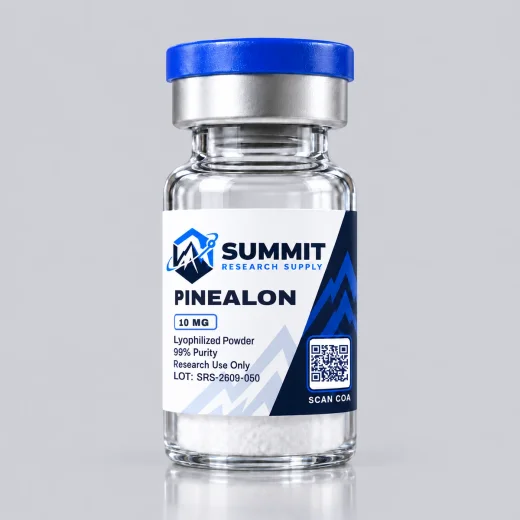
A simple reconstitution shopping list. Confirm vial size and batch documentation before you buy.
Pinealon
- Batch COA on every vial
- Third-party purity tested
- U.S. fulfillment, discreet shipping
Pinealon — frequently asked questions
What does this Pinealon calculator tell me?
It converts your vial size, bacteriostatic water volume, and target amount into concentration in mg/mL, draw volume in mL, and U-100 syringe units. It is a measurement tool, not a recommendation.
Is the Pinealon calculator free?
Yes — free, browser-based, and no account is required.
How many units is 500 mcg of Pinealon?
At 2.5 mg/mL (a 10 mg vial plus 4 mL) it is 0.2 mL, or 20 units. At 5 mg/mL it is 10 units. Units always depend on your exact concentration.
Is there an established Pinealon dose?
No usable one. The only human amount indexed in a peer-reviewed journal is oral — a 100 microgram capsule twice daily for two weeks — reported in a Russian-language abstract with no design details, and it cannot be converted into an injected amount. The injected figures that circulate come from a patent, which is not peer-reviewed and does not add up internally. The presets on this page are round arithmetic anchors, not studied amounts.
Has Pinealon been tested in people?
People have been given it in published reports, but calling them trials overstates matters. All of them are Russian-language, from 2012 to 2016, none is registered on ClinicalTrials.gov, none is an independent randomised controlled trial, most come from a single research network that also holds the commercial patent, and several give no amount or even a route. Read them as reports rather than as trials.
How long does Pinealon last in the body?
Unknown. We found no pharmacokinetic study of Glu-Asp-Arg in humans or in any animal, so any half-life figure quoted for it is uncited.
Is this medical advice?
No. This page and calculator are for education and research planning only. Products referenced are sold strictly as research chemicals and are not for human or veterinary use.
Sources & further reading
- Nazimko VA et al., Adv Gerontol 2012 (PMID 22708445) — the oral 100 mcg twice-daily report; English abstract only.
- Meshchaninov VN et al., Adv Gerontol 2015 (PMID 26390612) — reports prooxidant activity and a fall in CD34-positive cells.
- US Patent 8,524,674 B2 (Khavinson et al., 2013) — the source of the intramuscular figures. Patent, not peer-reviewed.
- Khavinson V et al. Pinealon increases cell viability, Rejuvenation Res 2011 (PMID 21978084) — cell-culture mechanism work.
- Fedoreyeva LI et al. Penetration of short fluorescence-labeled peptides into the nucleus, Biochemistry (Mosc) 2011 (PMID 22117547).
- Khavinson V et al. EDR peptide: possible mechanism of action, Molecules 2020 (PMID 33396470) — review by the originating group.
- Kozina LS, Adv Gerontol 2008 (PMID 18546826) — reports that these short peptides showed no direct antioxidant activity and raised intracellular reactive oxygen species.
- Mendzheritskii AM et al., Adv Gerontol 2011 (PMID 21809624) — reduced behavioural performance and moderately raised caspase-3 after pinealon before carotid occlusion.
- Mendzheritsky AM et al., Adv Gerontol 2015 (PMID 28509493) — finds Cortexin acts more strongly than pinealon on the same free-radical and caspase-3 measures.
- PubMed — all indexed pinealon records.
- ClinicalTrials.gov — search for pinealon; no registered studies.
- PubChem — Glu-Asp-Arg, CID 10273502 (C15H26N6O8, MW 418.40).
- General peptide reconstitution and storage best practices.
Related calculators
Pinealon protocol & evidence
There is no meaningful published dosing literature for Pinealon. The protocol page says so plainly rather than printing a number.