Cagrilintide Reconstitution & Dosage Calculator
This free cagrilintide calculator turns your vial size, the diluent you add, and your target amount into a concentration, a draw volume, and the exact units on a U-100 insulin syringe. Cagrilintide is a long-acting analog of amylin, a pancreatic hormone, and it is worth being clear about one thing before the arithmetic: it is not a GLP-1 agonist. It acts on the amylin and calcitonin receptors, a separate system from the incretins, even though it has been trialled alongside semaglutide.
Cagrilintide reconstitution calculator
Syringe
U-100 insulinPeptide in vial
Target amount
Bacteriostatic water
Email this result to yourself
Quick summary
- Converts vial size (mg), diluent volume (mL), and a milligram target into concentration, draw volume, and U-100 units.
- Reference math for the 10 mg vial, at the weekly milligram scale the published trials worked in.
- Educational research and measurement tool only — it does not diagnose, treat, or recommend an amount.
What this Cagrilintide calculator does
This calculator does one job well: it turns your vial size, the amount of bacteriostatic water you add, and your target amount into a concentration (mg/mL), a draw volume (mL), and the matching units on a U-100 insulin syringe. Change any input and the result updates instantly.
Cagrilintide ships as a freeze-dried powder. Before it can be measured into a syringe it has to be reconstituted — dissolved in bacteriostatic water. How much water you add sets the concentration, and the concentration sets how many units each amount works out to. The presets above cover the most common Cagrilintide vial setups; use the custom fields for anything else.
How to use the Cagrilintide calculator
Pick your syringe
Choose the U-100 insulin syringe you'll draw with. Smaller syringes (0.3 mL / 30u) have finer lines, which helps when the draw is small.
Enter your vial and water
Set the milligrams in your Cagrilintide vial and the bacteriostatic water you added. Together these set the concentration.
Set your target amount
Toggle mg or mcg and pick (or type) the amount you're measuring for. The calculator does the conversion for you.
Read the draw
The result panel shows concentration, draw volume, and the exact U-100 units to pull, plus how many doses your vial contains.
Cagrilintide reconstitution math, explained
The math is short. Concentration = vial size ÷ bacteriostatic water. Draw volume = target amount ÷ concentration. Units = draw volume × 100 (a U-100 syringe reads 100 units per mL). The table below shows common Cagrilintide setups and the units for a 1 mg amount at each.
| Vial size | Bac water | Concentration | Units per 1 mg |
|---|---|---|---|
| 10 mg | 1.0 mL | 10 mg/mL | 10 units |
| 10 mg | 2.0 mL | 5 mg/mL | 20 units |
| 10 mg | 3.0 mL | 3.33 mg/mL | 30 units |
Cagrilintide amount-to-units reference
How common amounts convert to U-100 syringe units at two example concentrations. These are arithmetic conversions for reference, not a recommendation of any amount.
| Amount | Volume (mL) | U-100 units |
|---|---|---|
| 0.5 mg (500 mcg) | 0.1 mL | 10 units |
| 1 mg (1000 mcg) | 0.2 mL | 20 units |
| 2 mg (2000 mcg) | 0.4 mL | 40 units |
| Amount | Volume (mL) | U-100 units |
|---|---|---|
| 0.5 mg (500 mcg) | 0.05 mL | 5 units |
| 1 mg (1000 mcg) | 0.1 mL | 10 units |
| 2 mg (2000 mcg) | 0.2 mL | 20 units |
Mixing, color & storage tips
It is not a GLP-1, and that is not a technicality
Cagrilintide agonises the amylin receptors and the calcitonin receptor. GLP-1 agonists such as semaglutide work through a different receptor entirely, so grouping cagrilintide with them misdescribes what it does. It has been studied both on its own and paired with semaglutide as CagriSema, but in every published trial the two were given as separate products or through a dual-chamber pen. No published data covers combining them in one research vial.
A weekly half-life changes the arithmetic
Reported terminal half-life is roughly 7 to 8 days, produced by a twenty-carbon fatty diacid side chain that binds albumin, and every human weight-management and diabetes trial dosed once weekly. That means a reconstituted vial sits in solution for weeks rather than days at the amounts the literature used — and there is no published stability or shelf-life data for lyophilised research-grade material once mixed.
The trial product was not a reconstituted vial
The phase 2 trial product was a ready-made solution for injection at 10 mg/mL, supplied in a pen cartridge, and the phase 3 combination used a dual-chamber single-use pen. Trial safety and tolerability data describe that pharmaceutical product. They say nothing about the identity, purity, sterility or stability of a vendor vial of powder.
Why this page does not print a titration ladder
Published weekly amounts span 0.16 mg to 4.5 mg, and the trials used two different escalation schemes that do not line up — one stepping every two weeks, another every four weeks with different steps, plus parallel arms that were never escalated at all. Chaining them into one sequence would invent a titration no trial ran. The escalation belongs on a protocol page carrying its own citation; the presets here are round arithmetic anchors chosen to read cleanly on the syringe.
Mixing and storage
Lipidated peptides foam readily, so add the diluent slowly down the inside wall and swirl rather than shaking. Refrigerate once in solution, keep it out of light, do not freeze a mixed vial, and discard anything cloudy. Native amylin is notoriously prone to forming fibrils, and cagrilintide was redesigned specifically to resist that — but that design work validates the pharmaceutical product, not a research vial.
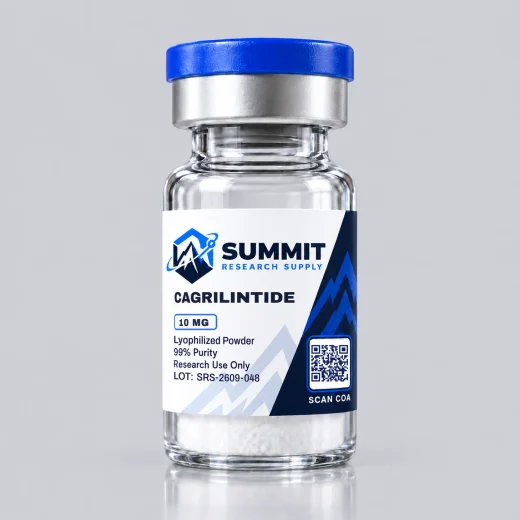
Cagrilintide supplies checklist
A simple reconstitution shopping list. Confirm vial size and batch documentation before you buy.
Cagrilintide
- Batch COA on every vial
- Third-party purity tested
- U.S. fulfillment, discreet shipping
Cagrilintide — frequently asked questions
What does this cagrilintide calculator tell me?
It converts your vial size, diluent volume, and target amount into concentration in mg/mL, draw volume in mL, and U-100 syringe units. It is a measurement tool, not a recommendation.
Is the cagrilintide calculator free?
Yes — free, browser-based, and no account is required.
Is cagrilintide a GLP-1 agonist?
No. It is an amylin and calcitonin receptor agonist. It has been trialled together with semaglutide as the combination CagriSema, which is probably why the two get filed together, but it is not an incretin and describing it as one is inaccurate.
How many units is 1 mg of cagrilintide?
At 5 mg/mL (a 10 mg vial plus 2 mL) it is 0.2 mL, or 20 units. At 10 mg/mL (10 mg plus 1 mL) the same amount is 10 units. Units always depend on your exact concentration.
Is there an established cagrilintide dose?
No. It is investigational, with no approved label found for it alone or in combination. Published weekly amounts in sponsor-run trials ran from 0.16 mg to 4.5 mg using two different escalation schemes, and nothing above 4.5 mg weekly has been studied in people. Those are trial amounts in defined populations, not a recommendation.
Why was it dosed once a week?
Because of the half-life. The fatty diacid side chain binds albumin, which stretches the terminal half-life to roughly 7 to 8 days and makes weekly injection practical.
What showed up in the trials?
Gastrointestinal effects dominate and rise with the amount given — nausea, constipation, diarrhoea and vomiting. In the phase 2 trial nausea ran 20% to 47% across the cagrilintide arms against 18% on placebo. That describes a monitored trial population given a pharmaceutical product, not a prediction for anyone else.
Is this medical advice?
No. This page and calculator are for education and research planning only. Products referenced are sold strictly as research chemicals and are not for human or veterinary use.
Sources & further reading
- Lau DCW et al. Once-weekly cagrilintide for weight management, dose-finding phase 2. Lancet 2021 (PMID 34798060).
- ClinicalTrials.gov NCT03856047 — the phase 2 trial, with posted per-arm escalation and adverse-event tables.
- Enebo LB et al. Cagrilintide with semaglutide 2.4 mg, phase 1b. Lancet 2021 (PMID 33894838) — source of the half-life range.
- Frias JP et al. Cagrilintide with semaglutide in type 2 diabetes, phase 2. Lancet 2023 (PMID 37364590).
- Garvey WT et al. Coadministered cagrilintide and semaglutide (REDEFINE 1). NEJM 2025 (PMID 40544433) — includes a cagrilintide-only arm.
- Kruse T et al. Development of cagrilintide, a long-acting amylin analogue. J Med Chem 2021 (PMID 34288673).
- Fletcher MM et al. AM833 is a novel agonist of calcitonin family GPCRs. J Pharmacol Exp Ther 2021 (PMID 33727283).
- Nielsen MJF et al. Cagrilintide pharmacokinetics in renal or hepatic impairment. Clin Pharmacokinet 2026 (PMID 42228334).
- PubChem — cagrilintide, CID 171397054.
- General peptide reconstitution and storage best practices.
Related calculators
Cagrilintide protocol & evidence
Dosing for Cagrilintide comes from published human trials. The protocol page carries the schedule that was actually administered, with the citation.