ARA-290 Reconstitution & Dosage Calculator
This free ARA-290 calculator turns your vial size, the diluent you add, and your target amount into a concentration, a draw volume, and the exact units on a U-100 insulin syringe. ARA-290, also called cibinetide, is an eleven-residue peptide modelled on the water-facing surface of a single helix of erythropoietin. Unlike most compounds at this end of the catalogue it has been given to people in published trials, and the scale matters for the arithmetic: draws are whole milligrams, so a 10 mg vial does not go far.
ARA-290 reconstitution calculator
Syringe
U-100 insulinPeptide in vial
Target amount
Bacteriostatic water
Email this result to yourself
Quick summary
- Converts vial size (mg), diluent volume (mL), and a milligram target into concentration, draw volume, and U-100 units.
- Reference math for the 10 mg vial at whole-milligram scale — a 1 mL U-100 syringe is the practical limit at 5 mg/mL.
- Educational research and measurement tool only — it does not diagnose, treat, or recommend an amount.
What this ARA-290 calculator does
This calculator does one job well: it turns your vial size, the amount of bacteriostatic water you add, and your target amount into a concentration (mg/mL), a draw volume (mL), and the matching units on a U-100 insulin syringe. Change any input and the result updates instantly.
ARA-290 ships as a freeze-dried powder. Before it can be measured into a syringe it has to be reconstituted — dissolved in bacteriostatic water. How much water you add sets the concentration, and the concentration sets how many units each amount works out to. The presets above cover the most common ARA-290 vial setups; use the custom fields for anything else.
How to use the ARA-290 calculator
Pick your syringe
Choose the U-100 insulin syringe you'll draw with. Smaller syringes (0.3 mL / 30u) have finer lines, which helps when the draw is small.
Enter your vial and water
Set the milligrams in your ARA-290 vial and the bacteriostatic water you added. Together these set the concentration.
Set your target amount
Toggle mg or mcg and pick (or type) the amount you're measuring for. The calculator does the conversion for you.
Read the draw
The result panel shows concentration, draw volume, and the exact U-100 units to pull, plus how many doses your vial contains.
ARA-290 reconstitution math, explained
The math is short. Concentration = vial size ÷ bacteriostatic water. Draw volume = target amount ÷ concentration. Units = draw volume × 100 (a U-100 syringe reads 100 units per mL). The table below shows common ARA-290 setups and the units for a 1 mg amount at each.
| Vial size | Bac water | Concentration | Units per 1 mg |
|---|---|---|---|
| 10 mg | 1.0 mL | 10 mg/mL | 10 units |
| 10 mg | 2.0 mL | 5 mg/mL | 20 units |
| 10 mg | 4.0 mL | 2.5 mg/mL | 40 units |
ARA-290 amount-to-units reference
How common amounts convert to U-100 syringe units at two example concentrations. These are arithmetic conversions for reference, not a recommendation of any amount.
| Amount | Volume (mL) | U-100 units |
|---|---|---|
| 1 mg (1000 mcg) | 0.2 mL | 20 units |
| 2 mg (2000 mcg) | 0.4 mL | 40 units |
| 4 mg (4000 mcg) | 0.8 mL | 80 units |
| Amount | Volume (mL) | U-100 units |
|---|---|---|
| 1 mg (1000 mcg) | 0.1 mL | 10 units |
| 2 mg (2000 mcg) | 0.2 mL | 20 units |
| 4 mg (4000 mcg) | 0.4 mL | 40 units |
Mixing, color & storage tips
What the published trials gave
Four milligrams subcutaneously once daily for 28 days is the most-repeated published regimen, appearing in a sarcoidosis trial (Dahan 2013), a type 2 diabetes neuropathy trial (Brines 2014) and the 4 mg arm of a phase 2b dose-ranging study (Culver 2017). Earlier work used 2 mg intravenously (Heij 2012). Those are amounts given to named patient groups under supervision and cited here for that reason, not recommendations. The dose-response was also not a straight line: in the only dose-ranging trial, the 4 mg arm met the primary endpoint while the 1 mg and 8 mg arms did not, and pain scores improved in every arm including placebo.
The evidence is small, short and mostly from one source
There is no phase 3 trial and no approved label anywhere. The trials ran 28 days, at most 12 weeks in an open-label study of nine people, on surrogate endpoints such as corneal nerve fibre density. Nearly all of them were funded by the developer with company officers as co-authors, and no independent group has replicated the efficacy findings. Adverse events were not absent either: the diabetes trial reported four serious adverse events in the treated arm, two judged possibly related, one of them worsening renal insufficiency that ended that participant involvement.
One vial is not many draws
A 10 mg vial holds two and a half times the 4 mg figure the trials most often used. Because there is no published shelf life for reconstituted material, choose a diluent volume around how quickly the vial will actually be used rather than defaulting to the largest number of readable units.
The trial vehicle was not bacteriostatic water
The clinical subcutaneous product came in sterile vials in a 20 mmol/L sodium phosphate buffer at pH 6.5 with 1% sucrose and 4% D-mannitol. For intravenous use, 2 mg was given in 6 mL of normal saline. No published aqueous solubility figure exists, and no published data covers benzyl-alcohol bacteriostatic water — so unlike dihexa there is no known co-solvent requirement, but there is also no stability study to lean on.
Identity is worth checking by mass
ARA-290 is the N-terminal pyroglutamate form at about 1257.3 daltons. The uncyclised glutamine version is a different molecule roughly 17 daltons heavier, and batches of the parent peptide were found to be mixtures of the two in the original work. A purity percentage without a matching mass does not tell you which one is in the vial. In serum the peptide is cleaved quickly by exopeptidases, so treat it as short-lived: refrigerate once in solution, protect from light, swirl rather than shake, and do not leave it at room temperature.
ARA-290 supplies checklist
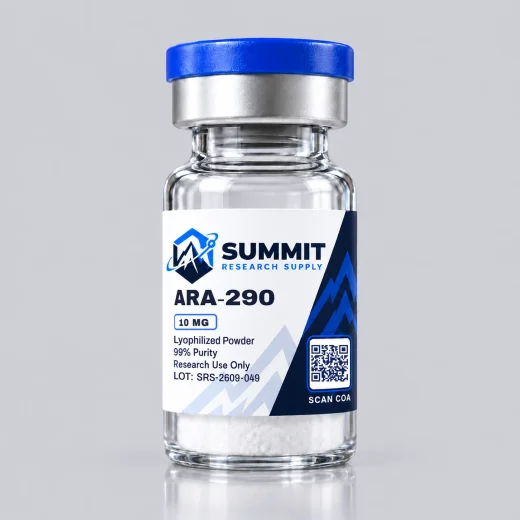
A simple reconstitution shopping list. Confirm vial size and batch documentation before you buy.
ARA-290
- Batch COA on every vial
- Third-party purity tested
- U.S. fulfillment, discreet shipping
ARA-290 — frequently asked questions
What does this ARA-290 calculator tell me?
It converts your vial size, diluent volume, and target amount into concentration in mg/mL, draw volume in mL, and U-100 syringe units. It is a measurement tool, not a recommendation.
Is the ARA-290 calculator free?
Yes — free, browser-based, and no account is required.
How many units is 4 mg of ARA-290?
At 5 mg/mL (a 10 mg vial plus 2 mL) it is 0.8 mL, or 80 units — most of a 1 mL U-100 syringe. At 10 mg/mL (10 mg plus 1 mL) the same amount is 40 units. Units always depend on your exact concentration.
Is there an established ARA-290 dose?
There is no approved label anywhere, so nothing is established in the regulatory sense. Published trials in named patient groups used 1, 2, 4 and 8 mg, with 4 mg subcutaneously once daily for 28 days repeated most often. Those figures describe what was administered in small, short, sponsor-funded studies; they are not a recommendation and the response across the tested range was not proportional to the amount.
Is ARA-290 the same as EPO?
No. It is an eleven-residue peptide designed from the shape of one surface of erythropoietin rather than a fragment cut out of it, and it was engineered specifically to avoid the red-cell-producing activity. That non-erythropoietic claim rests on rodent work and on 28-day human trials that did not report meaningful haematology changes, not on long-term human data.
Is ARA-290 banned in sport?
The WADA Prohibited List bans innate repair receptor agonists under S2.1.5. ARA-290 is not named there — the listed examples are asialo EPO and carbamylated EPO — but it is the prototypical compound of that class and anti-doping laboratory literature treats it as prohibited. An athlete should assume it is covered.
Is this medical advice?
No. This page and calculator are for education and research planning only. Products referenced are sold strictly as research chemicals and are not for human or veterinary use.
Sources & further reading
- Dahan A et al. ARA 290 in sarcoidosis-associated small nerve fiber loss, Mol Med 2013 (PMID 24136731) — 4 mg SC daily for 28 days.
- Brines M et al. ARA 290 in type 2 diabetes with neuropathic symptoms, Mol Med 2014 (PMID 25387363).
- Culver DA et al. Cibinetide and corneal nerve fiber abundance, IOVS 2017 (PMID 28475703) — the 1, 4 and 8 mg dose-ranging trial.
- Heij L et al. ARA 290 pilot study in sarcoidosis, Mol Med 2012 (PMID 23168581) — 2 mg intravenously.
- Lois N et al. Cibinetide for diabetic macular edema, J Clin Med 2020 (PMID 32674280) — open-label, primary endpoints not met.
- Cheung Tung Shing KS et al. Sci Rep 2018 (PMID 30127368) — independent biophysical work disputing the EPOR/beta-common receptor model.
- EMA — orphan designation EU/3/13/1191, cibinetide for sarcoidosis. A designation, not a marketing authorisation.
- WADA Prohibited List — S2.1.5, innate repair receptor agonists.
- PubChem — cibinetide, CID 91810664.
- General peptide reconstitution and storage best practices.
Related calculators
ARA-290 protocol & evidence
Dosing for ARA-290 comes from published human trials. The protocol page carries the schedule that was actually administered, with the citation.