AHK-Cu Reconstitution & Dosage Calculator
This free AHK-Cu calculator turns your vial size, the diluent you add, and your target amount into a concentration, a draw volume, and the exact units on a U-100 insulin syringe. AHK-Cu is GHK-Cu with alanine in place of glycine, and the difference worth knowing before you go further is the evidence behind it: PubMed indexes one peer-reviewed paper on the copper complex, and that work was done in culture rather than in people.
AHK-Cu reconstitution calculator
Syringe
U-100 insulinPeptide in vial
Target amount
Bacteriostatic water
Email this result to yourself
Quick summary
- Converts vial size (mg), diluent volume (mL), and a target amount into concentration, draw volume, and U-100 units.
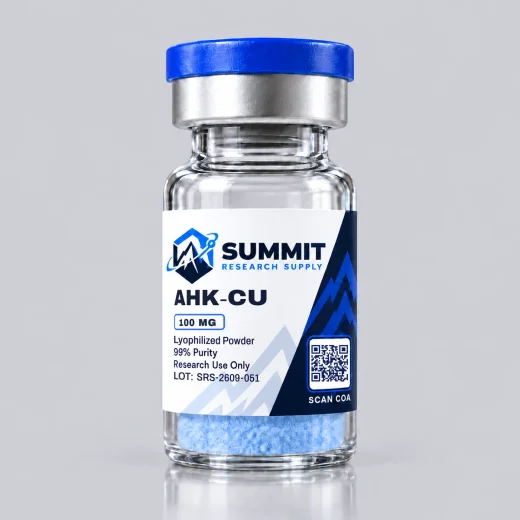
- Reference math for the 100 mg vial — a larger vial than most copper-peptide pages assume.
- Educational research and measurement tool only — it does not diagnose, treat, or recommend an amount.
What this AHK-Cu calculator does
This calculator does one job well: it turns your vial size, the amount of bacteriostatic water you add, and your target amount into a concentration (mg/mL), a draw volume (mL), and the matching units on a U-100 insulin syringe. Change any input and the result updates instantly.
AHK-Cu ships as a freeze-dried powder. Before it can be measured into a syringe it has to be reconstituted — dissolved in bacteriostatic water. How much water you add sets the concentration, and the concentration sets how many units each amount works out to. The presets above cover the most common AHK-Cu vial setups; use the custom fields for anything else.
How to use the AHK-Cu calculator
Pick your syringe
Choose the U-100 insulin syringe you'll draw with. Smaller syringes (0.3 mL / 30u) have finer lines, which helps when the draw is small.
Enter your vial and water
Set the milligrams in your AHK-Cu vial and the bacteriostatic water you added. Together these set the concentration.
Set your target amount
Toggle mg or mcg and pick (or type) the amount you're measuring for. The calculator does the conversion for you.
Read the draw
The result panel shows concentration, draw volume, and the exact U-100 units to pull, plus how many doses your vial contains.
AHK-Cu reconstitution math, explained
The math is short. Concentration = vial size ÷ bacteriostatic water. Draw volume = target amount ÷ concentration. Units = draw volume × 100 (a U-100 syringe reads 100 units per mL). The table below shows common AHK-Cu setups and the units for a 1 mg amount at each.
| Vial size | Bac water | Concentration | Units per 1 mg |
|---|---|---|---|
| 100 mg | 2.0 mL | 50 mg/mL | 2 units |
| 100 mg | 3.0 mL | 33.33 mg/mL | 3 units |
| 100 mg | 4.0 mL | 25 mg/mL | 4 units |
| 100 mg | 5.0 mL | 20 mg/mL | 5 units |
AHK-Cu amount-to-units reference
How common amounts convert to U-100 syringe units at two example concentrations. These are arithmetic conversions for reference, not a recommendation of any amount.
| Amount | Volume (mL) | U-100 units |
|---|---|---|
| 1 mg (1000 mcg) | 0.05 mL | 5 units |
| 2 mg (2000 mcg) | 0.1 mL | 10 units |
| 5 mg (5000 mcg) | 0.25 mL | 25 units |
| Amount | Volume (mL) | U-100 units |
|---|---|---|
| 1 mg (1000 mcg) | 0.04 mL | 4 units |
| 2 mg (2000 mcg) | 0.08 mL | 8 units |
| 5 mg (5000 mcg) | 0.2 mL | 20 units |
Mixing, color & storage tips
The presets are arithmetic, not amounts
No study supplies a human amount for AHK-Cu. The one peer-reviewed paper on the copper complex worked at 10 to the minus 12 through 10 to the minus 9 molar in culture medium, which is a concentration in a dish rather than a dose, and the animal figures come from unreviewed patent examples. The buttons here are round numbers chosen to make the units math readable.
Expect blue-purple, not blue-green
The ProCyte patent that first described these solutions calls them dark blue-purple, with peak absorbance around 563 to 580 nm at a 2:1 peptide-to-copper ratio and about 593 to 595 nm at 1.1:1 and 1:1. That is a different description from the blue or blue-green wording used for GHK-Cu, and because the colour depends on the ratio, a vendor that does not state its ratio has not told you what to expect.
Documented concentrations run about 1 to 15 mg/mL
The only published aqueous preparations are in that same patent: stock solutions of 10 mg/mL and 7.5 mg/mL in distilled water, pH adjusted to roughly 6.9 to 7.2, and injection solutions in sterile saline carrying up to 15 mg/mL. The 5 mL default here gives 20 mg/mL and the 2 mL preset gives 50 mg/mL, both above anything documented. That is undocumented rather than known to fail, but add diluent expecting to check that it actually goes clear.
You do not know how much copper is in the vial
Summit does not state the peptide-to-copper ratio, the salt form, or whether 100 mg refers to peptide or to the finished complex, and the patent made the complex at 2:1, 1.1:1 and 1:1 from acetate or dihydrochloride salts. Computed rather than sourced: copper is roughly 15% by mass of a neutral 1:1 complex and roughly 8% of a 2:1 complex, and salt forms push both lower. Copper per milligram is therefore unknown for any given vial.
Mixing, thiols and storage
Add diluent slowly against the inside wall and swirl gently rather than shaking. Keep copper peptides in separate vials from thiol compounds such as glutathione, which chelate and reduce copper(II) — that is general chemistry, not an AHK-specific finding. Store the dry powder cold, dark and dry, refrigerate once in solution, protect it from light, and discard anything cloudy, particulate or browned. No published stability or shelf-life data exists for this compound in bacteriostatic water.
AHK-Cu supplies checklist
A simple reconstitution shopping list. Confirm vial size and batch documentation before you buy.
AHK-Cu
- Batch COA on every vial
- Third-party purity tested
- U.S. fulfillment, discreet shipping
AHK-Cu — frequently asked questions
What does this AHK-Cu calculator tell me?
It converts your vial size, diluent volume, and target amount into concentration in mg/mL, draw volume in mL, and U-100 syringe units. It is a measurement tool, not a recommendation.
Is the AHK-Cu calculator free?
Yes — free, browser-based, and no account is required.
Is AHK-Cu the same as GHK-Cu?
No. They differ at the first residue: alanine instead of glycine. They are also not interchangeable as evidence. GHK-Cu has human topical cosmetic studies behind it and appears on FDA compounding lists; AHK-Cu has neither, so findings reported for GHK-Cu should not be read across to it.
Is there an established AHK-Cu dose?
No. PubMed indexes a single peer-reviewed paper on the copper complex — human hair follicles in organ culture plus cultured dermal papilla cells, treated at picomolar to nanomolar concentrations in the medium. Everything else is unreviewed mouse and rat-pup examples inside 1990s ProCyte patents. None of it converts into an amount for a person, and there is no human pharmacokinetic or safety data at all.
What colour should reconstituted AHK-Cu be?
The only published description is dark blue-purple, with the exact absorbance peak shifting with the peptide-to-copper ratio. Do not use the blue or blue-green expectation that circulates for GHK-Cu as a pass-fail test here.
Is Copper Tripeptide-3 its cosmetic ingredient name?
Not confirmed. Copper Tripeptide-3 is a seller name, not an INCI name, and it returns nothing in the EU CosIng database. CosIng does hold an entry called ALANINE/HISTIDINE/LYSINE POLYPEPTIDE COPPER HCL that cosmetic databases equate with AHK-Cu, but CosIng defines that substance as a polymer rather than the defined tripeptide, so the identity is not settled.
Is this medical advice?
No. This page and calculator are for education and research planning only. Products referenced are sold strictly as research chemicals and are not for human or veterinary use.
Sources & further reading
- Pyo HK et al. The effect of tripeptide-copper complex on human hair growth in vitro. Arch Pharm Res 2007 (PMID 17703734) — the one peer-reviewed paper on AHK-Cu.
- US Patent 5,538,945 — Stimulation of hair growth by peptide copper complexes (ProCyte). Patent, not peer-reviewed; source of the solution and animal figures.
- US Patent 5,550,183 — Metal-peptide compositions for stimulating hair growth (ProCyte); claims AHK-Cu as a compound.
- PubChem — Ala-His-Lys, CID 7408502 (free peptide: C15H26N6O4, MW 354.41).
- FDA — Bulk Drug Substances Nominated for Use in Compounding Under Section 503A; AHK-Cu is not listed in any category.
- EU CosIng — cosmetic ingredient database. Tripeptide-3 is defined there as a glycine/serine/valine peptide, and there is no Copper Tripeptide-3 entry.
- ClinicalTrials.gov — search for AHK-Cu; no registered studies.
- General peptide reconstitution and storage best practices.
Related calculators
AHK-Cu protocol & evidence
There is no established human dosing schedule for AHK-Cu — the published work is animal or cell-culture research. The protocol page explains what that work does and does not show.