Reference
Peptide glossary
The terms that turn up across reconstitution math, certificates of analysis and the protocol pages, defined in plain language. 51 entries.
51 terms
Agonist
A molecule that binds a receptor and activates it. Most research peptides are agonists at one or more receptors — the receptor it hits is usually the most informative thing about a compound.
Alpha-MSH
Alpha-melanocyte-stimulating hormone. The parent molecule behind the melanocortin compounds; KPV is its C-terminal fragment and Melanotan II is a synthetic analog.
Amino acid
The building block of peptides and proteins. Twenty standard amino acids appear in human biology, and a peptide is simply a short chain of them.
Amylin
A hormone co-secreted with insulin that contributes to satiety. Cagrilintide is a long-acting amylin analog.
Antagonist
A molecule that binds a receptor and blocks it rather than activating it — the opposite of an agonist.
Aseptic technique
Handling that avoids introducing microorganisms: swabbing the stopper, not touching the needle, and not leaving a vial open. It is the difference between a sterile vial and a contaminated one.
Bacteriostatic water
Sterile water containing 0.9% benzyl alcohol, which inhibits bacterial growth and allows a vial to be entered more than once. The default diluent for multi-use peptide vials.
Batch number
The identifier tying a specific production lot to its certificate of analysis. A COA whose batch number does not match your vial tells you nothing about your vial.
Benzyl alcohol
The preservative in bacteriostatic water, at 0.9%. It is what makes the water bacteriostatic rather than merely sterile.
Bioavailability
The proportion of an administered amount that reaches circulation intact. It is why route matters — an oral figure and an injected figure for the same compound are not comparable.
Cardiolipin
A phospholipid unique to the inner mitochondrial membrane. SS-31 binds it, which is the basis of its mitochondrial targeting.
Certificate of Analysis (COA)
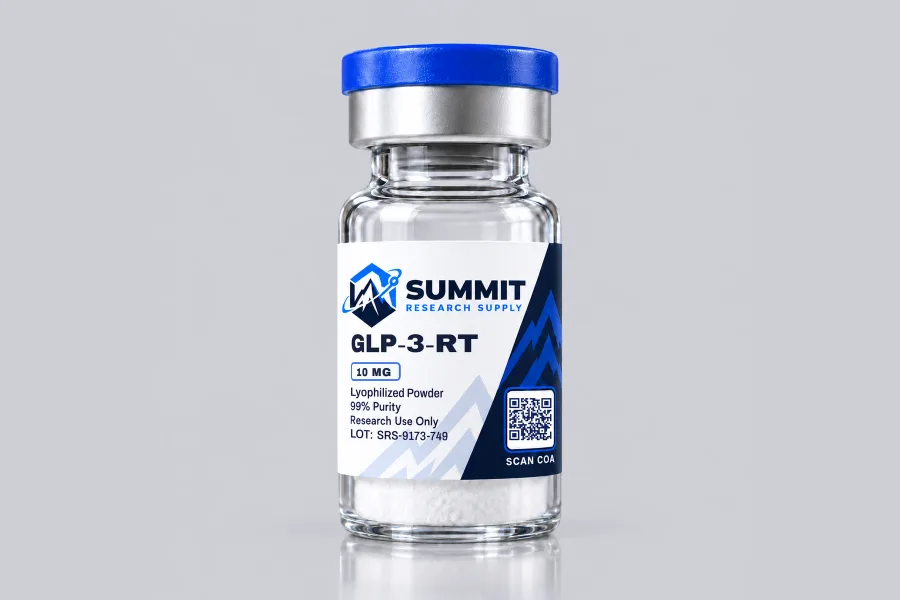
A laboratory document reporting the identity and purity of a specific batch. The useful ones show a chromatogram and a mass-spec identity, not just a number.
Chromatogram
The actual output trace from HPLC analysis. A purity percentage without the trace behind it is an assertion; the chromatogram is the evidence.
Concentration
Amount of compound per unit volume, in mg/mL. Equals vial size divided by the volume of water added — the number every draw calculation depends on.
DAC
Drug Affinity Complex. A maleimide group that binds covalently to serum albumin, extending half-life from minutes to days. CJC-1295 with DAC and without it are pharmacologically very different compounds.
Dead space
The volume left inside a syringe and needle after the plunger is fully depressed. It matters most with very small draws, where it can be a meaningful fraction of the amount.
Endogenous
Produced inside the body. Contrast exogenous — introduced from outside. Several research peptides are synthetic versions of endogenous molecules.
Excipient
An inactive ingredient in a formulation — bulking agents, stabilisers, buffers. Mannitol is a common excipient in lyophilized peptide vials.
Freeze-thaw
Repeated freezing and thawing, which damages peptides in solution through ice-crystal formation. It is the reason not to freeze a reconstituted vial.
Gauge
Needle diameter, inversely numbered — a higher gauge is a thinner needle. Insulin syringes are typically 29 to 31 gauge.
Ghrelin receptor
GHS-R1a, the receptor for ghrelin. Ipamorelin, GHRP-2 and GHRP-6 are agonists at it, and they differ mainly in how selectively they hit it.
GHRH
Growth-hormone-releasing hormone. Sermorelin, CJC-1295 and Tesamorelin are all GHRH analogs, acting on the pituitary rather than supplying growth hormone directly.
GIP
Glucose-dependent insulinotropic polypeptide. An incretin hormone; tirzepatide and retatrutide both agonise its receptor alongside GLP-1.
GLP-1
Glucagon-like peptide-1. An incretin hormone that slows gastric emptying and acts on appetite centres — the mechanism behind semaglutide.
Half-life
The time for circulating concentration to fall by half. It determines dosing frequency: a compound with a one-week half-life is dosed weekly, one with a five-minute half-life cannot be dosed the same way.
HPLC
High-performance liquid chromatography. The standard method for measuring peptide purity, and the source of the percentage figure on a COA.
Hygroscopic
Readily absorbing moisture from air. Lyophilized peptides are hygroscopic, which is why vials should be kept sealed and dry.
IGF-1
Insulin-like growth factor 1. The downstream mediator of many growth-hormone effects, and the marker that rises after GHRH-analog administration.
International Unit (IU)
A potency unit defined separately for each substance. There is no universal IU-to-mg conversion — a factor for one compound is meaningless for another.
Intramuscular (IM)
Injection into muscle tissue. Absorption is generally faster than subcutaneous.
Lyophilized
Freeze-dried. The stable form most research peptides ship in, and the reason they need reconstituting before use.
Mass spectrometry
Analysis measuring molecular weight, used on a COA to confirm the vial contains the compound it claims — identity, as distinct from purity.
MC4 receptor
Melanocortin receptor 4, involved in appetite and sexual function. PT-141 acts here; the non-selective Melanotan II hits it along with several others.
Myostatin
A TGF-beta family protein that limits muscle growth. Follistatin binds and neutralises it.
NNMT
Nicotinamide N-methyltransferase, an enzyme in NAD+ metabolism. 5-Amino-1MQ is an inhibitor of it.
PEGylation
Attaching polyethylene glycol to a molecule to slow its clearance. PEG-MGF is a pegylated form of mechano growth factor.
Peptide
A short chain of amino acids joined by peptide bonds. The boundary with "protein" is conventional rather than exact, usually drawn around 50 residues.
Potency
How much biological effect a given amount produces. Distinct from purity — a highly pure peptide can still be the wrong peptide.
Purity
The proportion of material in a vial that is the intended compound, measured by HPLC. Commonly reported as 98% or higher for research peptides.
Reconstitution
Dissolving lyophilized powder in a diluent — normally bacteriostatic water — to produce an injectable solution of known concentration.
Research Use Only (RUO)
A designation meaning material is supplied for laboratory research and is not for human or veterinary use. It is not a formality: RUO material is not manufactured to pharmaceutical standards.
Secretagogue
A substance that causes another substance to be secreted. Growth hormone secretagogues make the pituitary release its own GH rather than supplying GH directly.
Senolytic
An agent that selectively removes senescent cells. FOXO4-DRI is a designed senolytic peptide.
Sirtuin
A family of NAD+-dependent enzymes involved in metabolic regulation, and part of the rationale for interest in raising NAD+.
Sterile water
Water for injection with no preservative. Suitable for single-use vials, but it will not inhibit bacterial growth once a vial is entered, so bacteriostatic water is preferred for multi-use.
Subcutaneous (SC)
Injection into the fat layer beneath the skin. The most common route in the research-peptide literature.
Telomerase
The enzyme that extends telomeres. Claims about Epitalon centre on it, largely from cell-culture work rather than human outcomes.
Titration
Increasing an amount stepwise over time. In the GLP-1 trials it exists to manage gastrointestinal tolerability, not because lower steps are more effective.
U-100
An insulin syringe graduated at 100 units per millilitre, so one unit is 0.01 mL. Units measure volume, not the amount of compound in that volume.
U-40
A syringe graduated at 40 units per millilitre. Its markings mean something different from U-100 — reading one as the other is a fourfold error.
Vial septum
The rubber stopper on a vial, designed to reseal after a needle is withdrawn. Swab it before every entry.
For laboratory research use only. Definitions are educational. Compounds referenced are sold strictly as research chemicals and are not for human or veterinary use. Nothing here is medical advice.