What Is a Peptide? A Plain-English Primer
If you have arrived here without a biochemistry background, most explanations either patronise or drown you. This is the middle: what a peptide actually is, why it turns up as a white powder in a glass vial, and why the handling works the way it does.
A peptide is a short chain of amino acids
Amino acids are the building blocks of proteins. String a few together and you have a peptide; string a lot together and fold it up and you have a protein. The dividing line is arbitrary but usually sits around fifty amino acids.
For scale: BPC-157 is fifteen amino acids, KPV is three, and Semaglutide is a modified chain of thirty-one. These are small molecules by biological standards.
Why they act like signals
Because peptides are short and specifically shaped, they tend to work by binding receptors — fitting a particular site the way a key fits a lock — and triggering a response. That is why research descriptions talk about receptor agonists and signalling pathways rather than the compound being consumed as fuel.
It also explains why very small amounts matter. A signalling molecule does not need to be present in bulk to have an effect, which is why so much of this field is measured in micrograms.
Why they arrive as powder
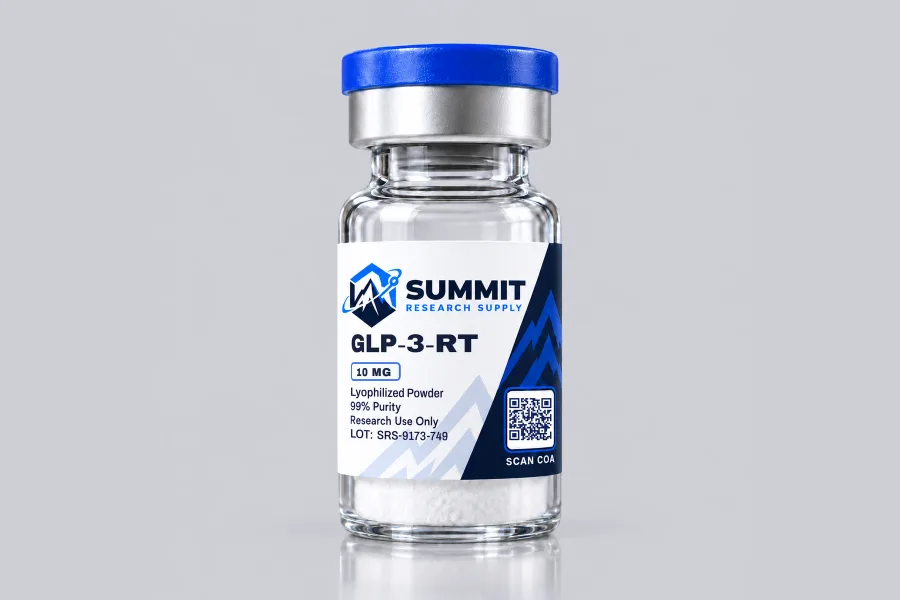
Peptides are fragile in solution. Suppliers ship them lyophilised — freeze-dried — because the dry powder is far more stable and survives storage and transport that a liquid would not.
That is why reconstitution exists as a step at all: you are rehydrating a stable powder into a usable solution, and from that moment the material is much more perishable.
Why injection rather than swallowing
The digestive system is very good at breaking peptides down — that is precisely what it does to dietary protein. A peptide swallowed is largely digested into constituent amino acids before it could act as a signal, which is why research handling generally uses injection.
There are exceptions engineered specifically to survive digestion, but they are the exception rather than the rule.
What this means for handling
Three practical consequences follow from the above. Peptides are fragile, so you swirl rather than shake. They are perishable once mixed, so reconstituted vials get refrigerated and used within a limited window. And amounts are small, so measurement precision genuinely matters — which is the entire reason this site exists.
The framing that applies to everything here
Compounds discussed across this site are research chemicals sold for laboratory use only. They are not approved medicines, nothing here is medical advice, and none of our tools recommend an amount — they convert numbers you supply into measurements you can read on a syringe.
Key takeaways
- A peptide is a short amino-acid chain; longer folded chains are proteins.
- They act as signals by binding receptors, which is why tiny amounts matter.
- They ship freeze-dried because peptides are fragile in solution.
- Digestion breaks them down, which is why research handling uses injection.