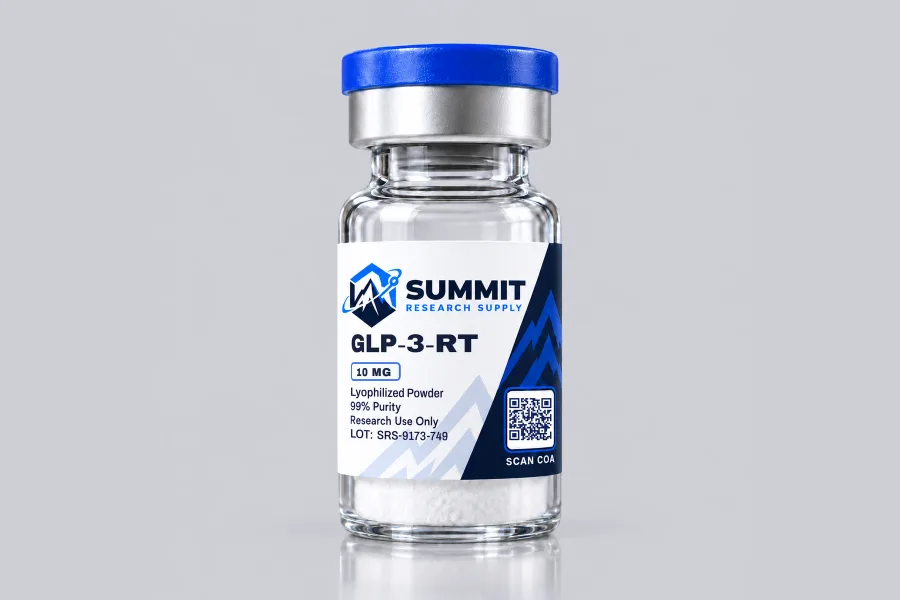
Semaglutide vs Tirzepatide vs Retatrutide: Mechanism Compared
These three are constantly compared and constantly conflated. The real difference is how many receptor pathways each one acts on — one, two, or three — and that difference cascades into the vial sizes they ship in and how their reconstitution maths behaves. This is a mechanism and measurement comparison, not a recommendation of one over another.
The short version
Semaglutide is a single GLP-1 receptor agonist. Tirzepatide is a dual agonist, adding GIP. Retatrutide is a triple agonist, adding glucagon receptor activity on top of both. More pathways does not automatically mean interchangeable handling — the practical amounts and vial strengths differ substantially.
Semaglutide — single agonist
Acts on the GLP-1 receptor alone and is the most extensively studied of the three, with the longest published record. Research vials are typically small — 2, 5 or 10 mg — and amounts are handled in fractions of a milligram.
That small scale is the practical catch: at a high concentration a target can land on just two or three syringe units, where reading error becomes a large percentage error. More dilution is usually the answer. The Semaglutide calculator has the reference tables.
Tirzepatide — dual GLP-1 / GIP agonist
Adds GIP receptor activity alongside GLP-1. Research vials are commonly larger — 10 through 60 mg — and setups frequently target 10 mg/mL or 20 mg/mL, which conveniently puts most draws on readable unit marks.
Of the three, Tirzepatide tends to produce the least awkward arithmetic, simply because vial strength and typical amounts line up well against a U-100 syringe.
Retatrutide — triple agonist
Adds glucagon receptor activity on top of GLP-1 and GIP, and is the newest and least-studied of the three — still investigational, with a much shorter published record. Vials commonly run 5 to 30 mg.
Published research on this class steps amounts up over weeks rather than starting at a target, so the syringe reading changes at each phase while the vial stays the same. That is exactly what the GLP-1 titration calculator converts.
Why the comparison is not a ranking
It is tempting to read "triple" as "strongest" and therefore "best". That is not how the evidence works. These compounds have different mechanisms, very different depths of published study, and different regulatory standing — Semaglutide and Tirzepatide have extensive trial records, Retatrutide is still investigational. Newer is not automatically better-understood, and none of this constitutes a recommendation.
What actually differs for measurement
Vial strength and typical amount scale are what change your arithmetic, not the receptor count. Semaglutide's small amounts push you toward more dilution for readability; Tirzepatide's larger vials usually land cleanly; Retatrutide's titration means recalculating at each step. Each compound has its own calculator with reference tables built in.
Key takeaways
- Semaglutide = GLP-1 only; Tirzepatide = GLP-1 + GIP; Retatrutide = adds glucagon.
- More receptor pathways does not mean better-studied — Retatrutide is the newest and least established.
- Vial strength and amount scale, not mechanism, drive the reconstitution maths.
- Semaglutide's small amounts benefit most from extra dilution for readable draws.