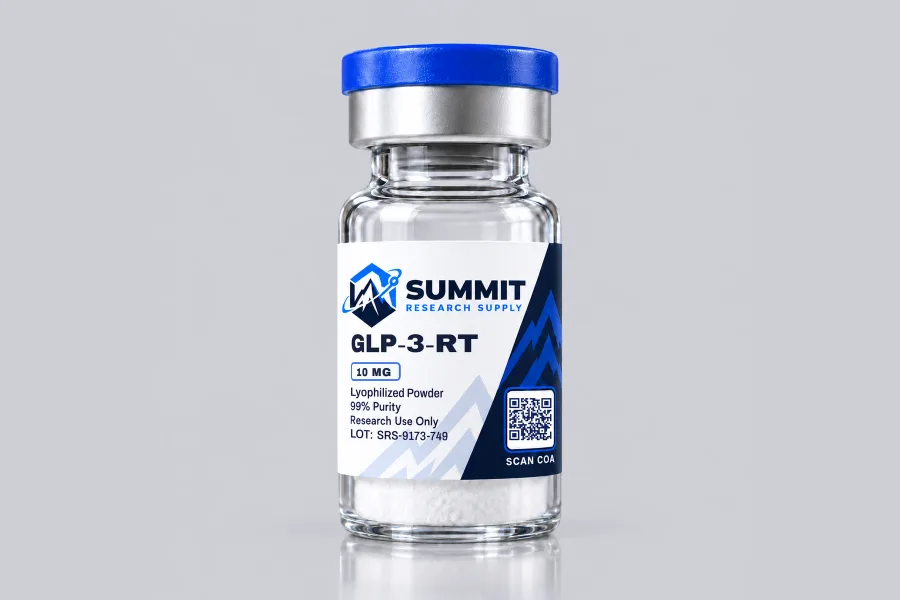
Peptide Purity Explained: What "99%" Actually Means
Almost every listing quotes a purity figure, usually 98% or 99%, and almost nobody explains what the number measures. It is a useful metric, but it answers a narrower question than most people assume — and on its own it cannot tell you whether the vial contains the compound on the label.
What the percentage measures
Purity is normally determined by HPLC — high-performance liquid chromatography — which separates the contents of a sample into peaks. The purity figure is essentially the size of the main peak as a proportion of all peaks detected.
So "99% pure" means the dominant component accounts for about 99% of what the method detected. It is a statement about proportion, not about identity.
Purity does not prove identity
This is the crucial gap. A sample can be 99% pure and still be 99% of the wrong compound. HPLC tells you how much of the sample is one dominant substance; it does not by itself confirm which substance that is.
Identity is established by mass spectrometry, which measures molecular weight and confirms the molecule matches the expected structure. A COA carrying both an HPLC purity figure and a mass spec identity confirmation is materially stronger evidence than purity alone.
What the remaining percent typically is
The balance is usually related peptide impurities from synthesis — truncated sequences, incomplete couplings, closely related fragments — plus residual solvents or counter-ions. These are ordinary byproducts of solid-phase synthesis rather than signs of anything unusual.
Net peptide content — the number people miss
Purity and net peptide content are different measures. A vial can be 99% pure while a meaningful fraction of its mass is water and counter-ions rather than peptide, which means the actual peptide mass can be lower than the label figure.
Where a supplier reports net peptide content alongside purity, that is a more complete picture. Most do not.
Why the batch number matters more than the number
A purity figure only describes the specific batch tested at the time it was tested. A COA from a different batch, or a single generic sample document reused across a whole catalogue, tells you nothing about the vial in your hand. Match the batch number on the certificate to the batch number on your vial — that check matters more than whether the figure reads 98% or 99%.
Reading the difference in practice
Independent third-party testing outranks in-house numbers, a chromatogram outranks a bare percentage, and HPLC plus mass spec together outrank either alone. Our COA reading guide walks through an actual certificate, and the COA checklist scores one.
Key takeaways
- Purity is the main HPLC peak as a proportion — a statement about proportion, not identity.
- A sample can be 99% pure and still be the wrong compound; mass spec confirms identity.
- Net peptide content differs from purity — actual peptide mass can be lower than the label.
- A COA only describes the batch it references; always match the batch number.